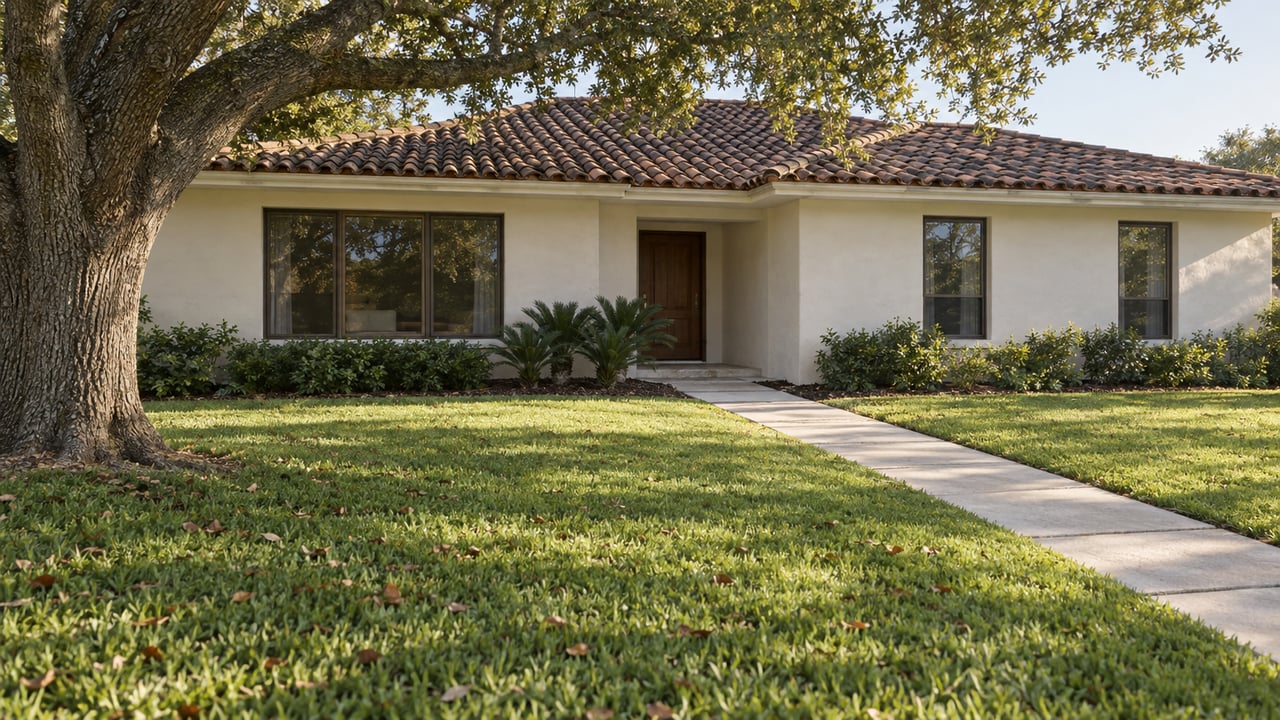
Two homes go under contract in Pinecrest the same month. Same acre-plus lot, same general block, same mature canopy out front. One closes near $700 a square foot. The other closes close to $1,900. Nothing about the listing photos explains the gap. The explanation is a single fact buried in the permit history: one house was built in 1968, the other in 2023.
Pinecrest's median sale price gets quoted constantly, and for good reason. It's the number every portal leads with. But a median built from a market this wide flattens something a buyer actually needs to know before making an offer. The village's active inventory splits into two distinct products that happen to share a zoning code. One is a mid-century ranch on a big lot. The other is a code-current rebuild on the same size lot. They are not the same asset, and pricing them as if they are is how buyers overpay for one and underbid the other.
The line runs through the Florida Building Code, not through the village limits
Miami-Dade County sits inside the High-Velocity Hurricane Zone, the strictest wind-design category in the Florida Building Code. That designation didn't always apply with the same force. The code buyers actually feel at the closing table today, the one that dictates roof attachment methods, impact-rated glazing, and how a house is wired and plumbed, took its current shape after Hurricane Andrew forced a rewrite of Florida's building standards in the 1990s.
A Pinecrest house built to that current code is a different insurance risk than a house built before it, even if the two sit on identical lots two doors apart. New construction arrives with documented roof age, tested opening protection, and modern systems an insurer can underwrite with confidence. A 1960s or 1970s ranch arrives with none of that documentation unless a prior owner already did the work, and proving it after the fact is its own project.
This is the fork that actually organizes the Pinecrest market. Not north versus south, not one street versus another, but pre-code versus post-code construction sharing the same acre-lot zoning that has defined the village since it incorporated in 1996.
What the price-per-square-foot numbers are actually showing you
Look past the headline median and the split becomes visible in the per-square-foot data. As of this summer, the typical active listing in the village was a house built around 1997, asking somewhere near $987 per square foot. That's the midpoint. It is not, however, where most individual listings actually sit.
Older homes on strong, well-located lots routinely price well below that per-foot figure. Buyers are paying primarily for the dirt and the lot's development rights, discounting the structure because they know a renovation or teardown is coming. New construction on a comparable lot commands a premium that can run close to double the median per-foot number, because the buyer is paying for a finished, code-current, insurable asset with no deferred work.
Put two listings side by side with identical square footage and identical lot size, and a few hundred dollars per square foot of difference isn't a pricing error. It's the market correctly pricing two different products. A buyer who treats that gap as negotiating room, rather than as a structural fact about what each house actually is, is going to lose the house priced correctly and overpay for the one that isn't.
Pinecrest has also become one of the more active teardown-rebuild markets in this part of Miami-Dade, which is exactly what you'd expect once a large share of the housing stock crosses fifty and sixty years old on lots too valuable to leave underbuilt. That activity is precisely why the per-foot spread keeps widening rather than converging. Every rebuild that closes resets the ceiling for the next comp.
Why a teardown in Pinecrest isn't just a demolition permit
Here's the friction that catches buyers who've done this in other Miami-Dade suburbs and assume the process transfers. In Pinecrest, you cannot get a building permit for new construction that involves removing a tree without first clearing a separate tree removal review administered by the Village's Building and Planning Department.
The village defines a specimen tree as one measuring 18 inches or more in diameter at breast height. If a lot contains specimen trees, and most mature Pinecrest lots do, an administrative official has to inspect the site and determine what happens to each one before any building permit tied to that removal moves forward. Removing a qualifying specimen tree isn't a matter of paying a fee and moving on. It triggers a replacement requirement of one and a half to two times the caliper removed, which on a single old growth oak can mean planting the equivalent of several new trees to satisfy the ratio.
The permit fee itself is modest, $156 for the first three trees and $30 for each additional tree, so cost isn't the barrier. Time is. A renovation plan that assumed a clear lot has to be redrawn around whichever specimen trees the village determines should be preserved or relocated rather than removed. For a buyer underwriting a teardown, that's a design and scheduling variable that shows up after closing, not before, unless the tree survey happens during due diligence instead of after it.
This is also why some rebuilt lots in Pinecrest still carry mature canopy right up against a new structure and others were cleared and replanted from scratch. It isn't always an aesthetic choice. Sometimes it's what the tree ordinance allowed.
The insurance line that shows up after closing
Flood zone designations vary meaningfully within the village, including along the Snapper Creek corridor, and that variation doesn't track cleanly with construction era at all. It's a separate variable that stacks on top of the pre-code versus post-code split rather than replacing it.
Windstorm coverage is the bigger line item for most owners here, because every Miami-Dade policy carries a separate hurricane deductible calculated as a percentage of dwelling coverage rather than a flat dollar figure. Premium on that line is driven heavily by roof age, roof material, documented opening protection, and other wind mitigation features an insurer can verify. On a 1960s ranch, those three items often decide whether the house is economically insurable at standard rates at all, which is why they belong in the offer analysis stage, not left for the final walkthrough.
What this actually means if you're comparing two listings right now
A buyer looking at Pinecrest inventory this fall is really choosing between two different ownership experiences that happen to share a zoning code:
- A pre-code home priced to reflect the lot, with the renovation or rebuild budget, the tree survey, and the insurance underwriting still ahead of you
- A post-code home priced to reflect a finished, insurable structure, with the tree and permit questions already resolved by whoever built it
Neither is the better financial decision in the abstract. It depends on whether you're buying time or buying flexibility. What the median sale price will never tell you is which one you're actually looking at, and treating a $600 gap in price-per-square-foot as pure negotiating room, rather than as two different products, is the mistake that costs buyers the most in this specific market.
A few questions worth asking before you write an offer
Before comparing two Pinecrest listings on price alone, it's worth getting direct answers to a short list of questions: What year was the roof last replaced, and does it carry documented wind mitigation credits? Has a tree survey been done on the lot, and does it identify any specimen trees that would need relocation or replacement under a renovation plan? And has the seller obtained a current insurance quote, not an estimate, that reflects the home's actual age and systems?
Those three answers will tell you more about what you're really paying for than the comp sheet will.
FAQ
Does every renovation in Pinecrest require a tree permit, or only teardowns? Any construction project that involves removing or relocating a tree requires a permit first, and if the project also needs a building permit, the tree removal permit has to be resolved before that building permit is issued. A kitchen remodel that doesn't touch the yard typically isn't affected. A pool addition or a new footprint usually is.
Is the pre-1994 versus post-1994 code split something a home inspector will flag? A standard inspection will note roof age and general condition, but documenting wind mitigation features and code compliance in enough detail for an insurer usually requires a separate wind mitigation inspection, which is worth ordering during due diligence rather than assuming it matches the seller's disclosure.
Where can I read the actual tree ordinance instead of a summary of it? The full requirements are in Article 6 of the Village of Pinecrest's Land Development Code, available through the village's Municode library, and the permit process itself is outlined on the Village of Pinecrest's tree removal permit page.
If you're comparing two Pinecrest lots and the price-per-square-foot math isn't adding up, that's usually the tell that you're pricing two different products against each other. Rebecca Sundel can walk the comps with you, construction era by construction era, before you write the offer.